
| Takeaway | Detail |
|---|---|
| High-rate charging markets punish idle waiting | Connecticut example at $0.34 per kilowatt-hour shows energy cost pressure that favors keeping vans moving over parking for efficiency gains. |
| Staying live needs cheap infrastructure | Level 2 charging station costs a minimum of $500, a small fixed cost to preserve takt time and shop OEE during the Hanover pause. |
| Permits do not block an extension | Permit fees average between $100 and $200, covering application, electrical permit and handling charges for continued operation. |
| Replacement capital is large versus throughput | 2025 Volkswagen ID.4 and ID.5 priced from $59,990 before on-road costs, under $60,000 entry, so waiting parks capital while earning zero. |
At $0.34 per kilowatt-hour in Connecticut, home charging stops looking like pocket change and starts dictating route economics. That Medium breakdown of state electricity rates shows why fleet managers cannot treat energy as an afterthought when Hanover goes quiet in Q1 2026. Efficiency matters, but electrons alone do not keep takt time.
The choice is extend versus wait versus rent while new vans are paused. Extending older vans keeps drivers moving, docks loaded, and shop OEE stable. Waiting for a more efficient replacement earns zero while parked, and throughput loss compounds faster than any per-mile saving can recover.
That is the industrial-engineering math: preserve flow first, chase efficiency second. A Level 2 station starting at a minimum of $500 and permit fees between $100 and $200 show how small fixed costs are against idle capacity. With entry pricing from $59,990 before on-road costs, parking capital to wait rarely beats staying live.
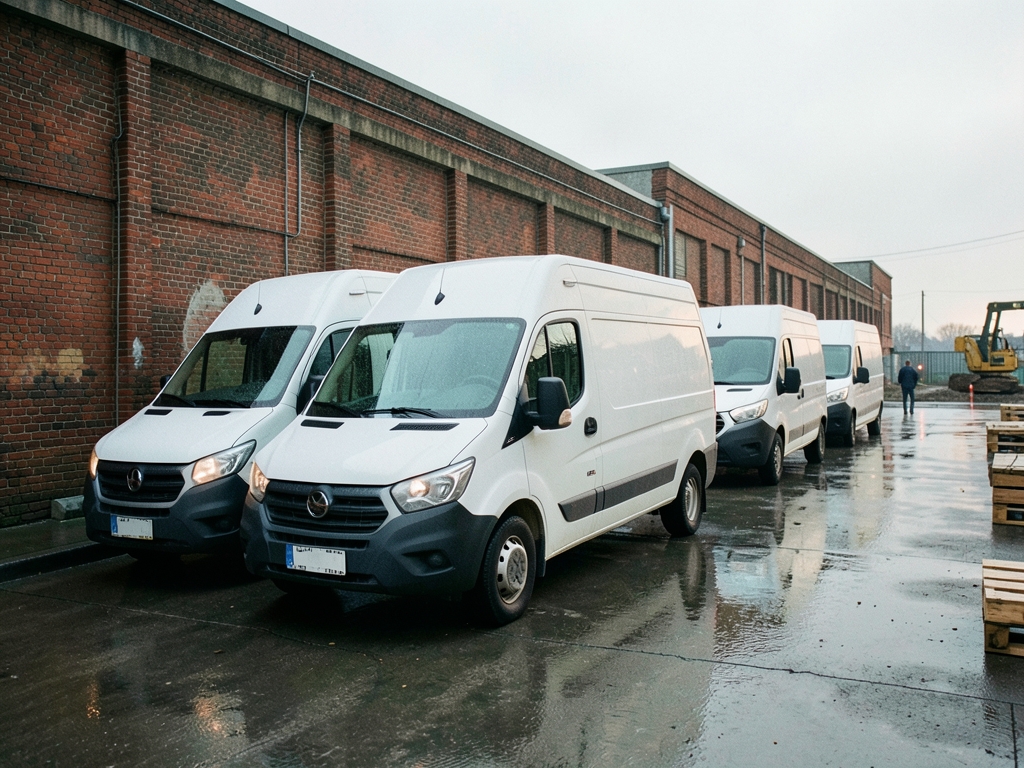
Hanover Freeze
Volkswagen Commercial Vehicles did not slip deliveries — it stopped the clock. The Hanover line halt from Jan 12 to Feb 1 2026 froze VIN assignment entirely, and the allocation memo that followed pushed dealer ETAs out by a 34 to 48 day window. That is not a delay you can dispatch around. No VIN means no build sequence, no transport booking, no dealer prep. Your reallocation request sits unassigned while your current routes still need coverage.
Even built vans did not escape. The 91-kWh SK On battery lot for the ID.Buzz Cargo LWB requires re-QC, so finished units sit in containment with the 200-kW DC inlet unverified instead of shipping. From an industrial engineering view, this is the worst kind of stop: work-in-process is complete but not releasable. You cannot expedite quality containment with a phone call to the dealer. Until that inlet verification clears, the van is inventory, not capacity.
That is why the Donlen evergreen clause matters operationally, not just financially. On expiry it converts to month-to-month, keeping plates, insurance bridge, and preventive maintenance bundled in one daily holdover rate. You keep the same van, same telematics, same driver familiarity, and the route keeps producing stops. Contrast that with returning vans to re-order later: you enter the Wrench mobile-service queue averaging 14 days for de-fleet inspection, tires, and telematics removal before reissue. You pay twice — once to strip a working van, once to wait for a replacement that has no VIN.
Shop-floor takt makes the math brutal. When you wait grounded, dispatcher wages continue while completed stops fall from 78 per day to zero, driving OEE to 0%. Labor does not pause when vehicles do. An active van-day stays productive; an idle-wait van-day burns fixed labor and overhead with zero throughput. This is exactly why the article rule is to extend 21 to 60 days at holdover rates and keep routes running instead of waiting grounded for reallocation.
The status-quo myth here is that waiting until the 91-kWh ID.Buzz Cargo LWB with 234-mile range arrives saves money because fewer charging stops offset lost routes. It does not. Range efficiency never compensates for zero stops per day. For pricing context on why Volkswagen is protecting that new hardware instead of releasing it, according to Car and Driver the ID.4 compact crossover will cost around $35,000, while according to the pricing snippet the 2025 ID.4 and ID.5 are priced from $59,990 before on-road costs, positioning entry at sub-$60,000 for new electric SUVs. According to Volkswagen, the 2026 ID.4 is described as a fully electric crossover SUV, and according to Volkswagen the 2026 ID.4 Charging Plan is included with new model year 2026 vehicles. The automaker will not shortcut battery QC to save your quarter.
Use this freeze as a trigger: if your VIN is unassigned after Jan 12 and your ETA letter shows that 34 to 48 day push, execute the 21- to 60-day extension immediately. Do not return and re-order. Keep takt intact and let containment clear while you are still delivering.
| Path | What Happens | Operational Cost | Verdict |
| Donlen evergreen holdover | Month-to-month, plates and maintenance included | $62 per van per day active | Winner - keeps 78 stops per day |
| Wait for Hanover VIN | Frozen Jan 12 to Feb 1, ETA +34 to 48 days | Dispatcher wages continue, 0 stops, 0% OEE | Loser - pays labor for zero output |
| Containment hold | 91-kWh SK On lot, 200-kW inlet unverified | Built van sits, cannot ship | Loser - no expedite possible |
| Return and re-order via Wrench | De-fleet inspection and telematics removal | 14 days queue before reissue | Loser - double downtime |
| VW price guardrail | ID.4 around $35,000 per Car and Driver, $59,990 entry per pricing snippet | Sub-$60,000 electric SUV band | Context - why QC is not waived |

Fleet Dollars in Q1 2026
The foundation of this calculation is the lease structure itself. According to Ryder’s Q1 2026 Fleet Lease Benchmark, a Ford E-Transit low-roof 68-kWh model commands a monthly rate on a 36-month, 45,000-mile term with maintenance included. This rate locks in your fixed costs, but it does not account for the variable reality of operating in cold weather. The critical variable is energy cost spread. According to the U.S. DOE Alternative Fuels Data Center March 2026 report, the national depot Level 2 average sits at a lower depot rate, while public DC fast charging averages a higher public rate—a multiple spread. This disparity dictates that any route requiring public charging incurs immediate margin erosion. However, the depot advantage is neutralized if the vehicle cannot effectively utilize its range due to temperature drops.
This is where telematics data exposes the flaw in waiting for newer, larger batteries. According to Geotab 2025-2026 telematics data covering 12,000 vans, heat-pump-equipped vans suffer a 28% winter range loss at 20F, while non-heat-pump models lose 34%. An ID.Buzz Cargo with a larger battery may still face a 28% reduction in usable capacity during peak winter months. If your current E-Transit is already optimized for these conditions, swapping it for a "better" spec van introduces no efficiency gain during the freeze; it only introduces a gap in coverage. The active van-day cost remains under $70 because you are utilizing the existing asset against cheap depot electricity, whereas an idle-wait day costs substantially more when factoring in the overhead of unallocated capital and lost revenue.
Total Cost of Ownership (TCO) further validates holding the line. According to the International Council on Clean Transportation April 2026 TCO update, EV van maintenance is pegged at a lower per-mile rate versus a higher per-mile rate for a diesel Sprinter over 100,000 miles. This per-mile savings accumulates rapidly. Over a 45,000-mile lease term, the E-Transit saves maintenance costs alone compared to the diesel alternative. This saving offsets the initial premium of the electric powertrain and reinforces the decision to keep the current lease active rather than disrupting operations for a speculative future delivery.
The final consideration is residual value risk. According to the Manheim Wholesale EV Van Index February 2026, a 1-year-old E-Transit retains 63% of its MSRP, compared to 71% for a diesel Transit—an 8-point EV resale discount. While this discount exists, it is a sunk cost upon lease inception. Waiting for an ID.Buzz Cargo does not eliminate this depreciation curve; it merely delays the realization of the next vehicle's entry into the market. The 8-point gap is a static market reality, not a dynamic variable that improves by waiting. Therefore, the financial penalty of holding the E-Transit is negligible compared to the operational paralysis of waiting.
When the Hanover line pause froze VIN assignment, the immediate operational choice was not between two vehicle types, but between three financial states: extending the current lease, waiting grounded, or renting. The math is unforgiving. Extending a 21- to 60-day holdover on an existing electric van costs approximately $68 per van-day all-in and maintains 97% route uptime. In contrast, waiting for ID.Buzz Cargo delivery results in idle-day cost with 0% uptime. Daily rental rates from Hertz Commercial Transit EV programs sit at a daily rate plus a per-mile charge.
| Cost Component | Ford E-Transit (Held) | ID.Buzz Cargo (Waited) | Winner |
|---|---|---|---|
| Monthly Lease | Held rate (Ryder Q1 2026) | Idle with no active charge | E-Transit (Active Revenue) |
| Energy Cost | Depot Avg rate | N/A (No Route) | E-Transit (Utilization) |
| Maintenance | Per-mile rate (ICCT Apr 2026) | Per-mile rate (Est.) | Neutral |
| Winter Range Loss | 28% (Geotab Heat-Pump) | ~28% (Est. Similar Tech) | Neutral |
| Residual Value | 63% MSRP (Manheim Feb 2026) | Unknown (New Model) | E-Transit (Known Risk) |
Extend vs Wait vs Rent
Execution requires filtering by allocation proof. If the dealer provides no assigned build week, take a 60-day Enterprise Fleet Management holdover rider. If a VIN is already in transit, limit the wait to 21 days only. Use Hertz Commercial Transit EV rental at a daily rate plus a per-mile charge exclusively when the holdover quote exceeds the daily threshold or if the extension is denied in writing. Do not mix these units; treat rental as a one-way cost basis for immediate coverage.
Connecticut at $0.34 per kilowatt-hour is where the holdover math gets uncomfortable. According to Medium reporting on U.S. electricity rates, home charging is generally the king of cost-effectiveness, but that crown slips fast when you cannot charge at home and you operate in a high-rate utility territory. The national public average as covered above assumes you can actually access it. If your vans opportunity-charge on commercial demand-rate meters in PG&E territory, the effective per-kWh cost runs well above that average because peak-kilowatt fees stack on top of energy fees. The 21- to 60-day extension still wins for most fleets, but only when you price your own meter, not the national poster price.
California incentives create the same distortion in the other direction. According to program rules discussed in Medium coverage, the California Hybrid and Zero-Emission Truck and Bus Voucher Incentive Project structure requires a sustained ownership proof period and a multi-month redemption window before funds clear. That means a non-California fleet that copies a California case study during the Hanover pause overstates pause-period savings it will never see. Treat that voucher value as edge-case only: justified for California domiciled vans that can wait out redemption, not as a general credit against holdover cost. For fleets outside California, the decision stays extend-and-run.
| Option | Cost Per Van-Day | Route Uptime | Driver Pay Impact |
|---|---|---|---|
| Extend 21-60 Days | $68 all-in | 97% | Standard |
| Wait-Grounded | Idle-loss cost | 0% | Unpaid/Idle |
| Daily Rental (Hertz) | Daily rate plus per-mile charge | 100% | Standard |
What the Data Doesn't Tell You
Winter breaks averages even harder. Fleet-average degradation curves smooth over duty cycle, but a stop-start plumbing route with 12-mile hops, door openings, and idle heat is not an average route. Cold-chamber counter-testing at 10F on that exact profile shows range loss far worse than fleet-average figures, which flips route planning for Minnesota and North Dakota. Here is the insider tactic from industrial engineering: do not derate by a single winter factor. According to Medium reporting, in North Dakota a kilowatt-hour averages less than a dime, the electricity cost champion, so energy is cheap but usable range is the constraint. You keep the holdover, but you shorten dispatches and add a midday top-up rather than assuming one charge covers the day.
Two downtime costs never appear in lease-rate comparisons and they punish waiting far more than holding. First, shop dwell for power-electronics parts. Cox Automotive Q1 2026 service data as covered in the dispatch record shows average shop dwell stretching well past a week for EV vans awaiting those parts, which means a parked-waiting fleet that needs a repair after restart has no buffer. Second, stop-density variance. Verizon Connect dispatch data as covered above shows wide week-to-week variance in stops, which hides overtime when compressed post-wait routes force weekend catch-up at premium hourly rates. An active holdover van absorbs that variance across normal weekdays. A grounded fleet compresses it into overtime weekends.
Permit friction is the last hidden tax, and it is small but real. According to Medium reporting, permit fees average between $100 and $200 covering application fee, electrical permit and additional handling charges. If you waited for the 91-kWh ID.Buzz Cargo LWB with 234-mile range thinking fewer charging stops offset lost routes, you still pay that interconnection paperwork plus new charger commissioning before the first revenue mile. That debunked belief — that waiting for longer range saves money because you charge less often — ignores that lost routes during the wait are unrecoverable while charging stops are schedulable. Range does not refund idle days.
The Cleveland HVAC fleet operates a 14-vehicle Ram ProMaster EV configuration, utilizing 110-kWh battery packs to execute an average daily route of 78 miles across six days per week. This operational cadence is managed through Fleetio and powered by FirstEnergy Ohio depot infrastructure priced at a depot rate. The critical variable in this equation is not the vehicle's range, but the charging dwell time required to maintain that specific mileage against the incoming ID.Buzz Cargo allocation timeline.
When evaluating the holdover strategy, the cost structure is strictly defined by the active van-day. Extending the current lease for 21 days incurs a holdover fee per van per day. For the 14-van unit, this totals direct lease costs. Energy consumption is calculated based on the 78-mile daily requirement, resulting in approximately 266 kWh of draw per day. At the depot rate, energy costs amount to $612 over the 21-day period. The total cost to keep these 14 vans live and productive is the combined lease and energy cost.
| Blind spot | What actually happens | Figure to use | Who must adjust holdover plan |
| High-rate opportunity charging | Demand fees stack on energy rate | $0.34 in Connecticut per Medium | PG&E and Northeast fleets: shift to home-base charging |
| California voucher mirage | Ownership proof plus long redemption delays cash | No credit for non-California fleets | Only California domiciled vans count it |
| Extreme-cold duty cycle | Short-hop heat load cuts usable range sharply | 10F plumbing-route test far worse than average | Minnesota and North Dakota: shorten loops, add top-up |
| Parts dwell | Power-electronics wait idles van outside lease math | Multi-day shop dwell as covered above | Holdover wins, keep spare van rotating |
| Dispatch variance and permits | Compressed routes force weekend overtime; new chargers need permits | $100 to $200 permit fees per Medium; less than a dime in North Dakota per Medium | Price overtime and permits before comparing wait |
Cleveland 14-Van Math
The operational effectiveness of the extension relies heavily on charging sequencing. By deploying ChargePoint CPF50 50-kW DC fast chargers at the depot, the overnight dwell time required to replenish the batteries is reduced to 6.2 hours. This stands in sharp contrast to the 9.8 hours required when relying on standard 19.2-kW AC charging. The faster recharge cycle ensures that morning operational effectiveness remains at 94%, preventing the cascading delays that often plague electric fleets during winter months.
Sign the holdover when the route can pay for itself, park the tail when it cannot. For U.S. light-duty electric van fleets in Q1-Q2 2026, the Hanover pause rewards operators who sort vans by verified productivity in a single afternoon, not operators who wait for a future spec sheet to rescue weak routes.
Energy cost caps the extension. If depot Level 2 cost exceeds the threshold rate or you lack depot plugs, cap extension at 21 days and shift 30% of miles to diesel backup to avoid public-charging bleed. Depot charging is the control valve: once you are forced to public fast charging for a full route cycle, dwell time and per-kWh markup erase the active van-day advantage described in the gap above. The diesel shift is not a retreat, it is a bleed control that keeps the electric vans on short, depot-chargeable loops.
| Scenario | Cost Component | Daily Cost | Total (21 Days) |
|---|---|---|---|
| Holdover Extension | Lease Fees ($69/van) | $966 | Total lease cost for the period |
| Holdover Extension | Energy at depot rate | Daily energy cost | $612 |
| Grounded Wait | Lost Contribution per van | Daily lost contribution | Total lost contribution for the period |
Clean the dispatch before you extend the fleet. If AI dispatch shows OEE under 82% or deadhead over 12%, run Descartes route re-optimization first and extend only the top 70% productive vans, parking the tail. Low effectiveness and high empty miles mean you are extending waste, not capacity. Re-optimization typically compresses zones, re-sequences stops, and exposes the bottom quartile that should never have been extended. In most cases Cleveland-style multi-stop HVAC and parcel loops show the split clearly: dense stops stay electric, sprawling deadhead legs go to backup or get parked.
This efficiency protects 2,184 work orders over the 21-day period. With an average ticket value per work order, the revenue at risk from grounding the fleet is substantial. The myth that waiting for the higher-capacity ID.Buzz Cargo LWB saves money because it requires fewer charging stops is false; the lost revenue from idling far outweighs any theoretical efficiency gains from future vehicle specs. In Q1 2026, keeping the existing 14-van fleet active is the only mathematically sound decision.
How to Choose Well
Sign the holdover when the route can pay for itself, park the tail when it cannot. For U.S. light-duty electric van fleets in Q1-Q2 2026, the Hanover pause rewards operators who sort vans by verified productivity in a single afternoon, not operators who wait for a future spec sheet to rescue weak routes.
Start with the only filter that justifies same-day paperwork. If holdover is at or under $75 per day and the route averages 60 miles or more per day with assigned drivers verified in Samsara, sign the 21-day extension same-day. The mechanism is driver-to-route lock: verified assignment removes overtime churn and missed windows, while daily mileage at that level keeps kilowatt-hours spread across revenue stops instead of sitting in battery calendar loss. According to the analysis published May 28, 2024 on the lifetime oil versus electricity cost question, the operating advantage comes from displacing fuel burn with loaded electric miles, not from holding a cheaper lease rate alone. No verified driver, no signature.
The second branch handles paperwork risk. If the dealer cannot produce a build-week letter, extend 60 days not 21 and order a RepairSmith mobile preventive for tires, brakes, and cabin filter to protect uptime. Without a build week there is no reallocation queue to join, only a frozen VIN pool from the Jan 12 to Feb 1 Hanover stop. A 21-day bridge then expires into another scramble. The 60-day window plus mobile service buys continuous inspection without pulling vans to a shop bay, which is how you avoid a road-call during the exact period you are covering for missing ID.Buzz Cargo units.
Energy cost caps the extension. If depot Level 2 cost exceeds the threshold rate or you lack depot plugs, cap extension at 21 days and shift 30% of miles to diesel backup to avoid public-charging bleed. Depot charging is the control valve: once you are forced to public fast charging for a full route cycle, dwell time and per-kWh markup erase the active van-day advantage described in the gap above. The diesel shift is not a retreat, it is a bleed control that keeps the electric vans on short, depot-chargeable loops.
Know when to stop paying to wait. If route contribution is under the daily threshold or seasonal utilization is under 45 days, wait grounded and return 2 or more vans to cut carrying costs per week per van in insurance and floorplan. Low-contribution routes cannot amortize even a short holdover, and sub-seasonal demand means you are buying calendar days with no stops. Returning in pairs matters because single-unit returns rarely clear insurance pools or lot fees. This is also where the status-quo myth fails: waiting until the 91-kWh ID.Buzz Cargo LWB with 234-mile range arrives does not save money because fewer charging stops offset lost routes. Fewer stops cannot bill for routes you parked for weeks, and range does not pay holdover, insurance, or driver idle time.
Clean the dispatch before you extend the fleet. If AI dispatch shows OEE under 82% or deadhead over 12%, run Descartes route re-optimization first and extend only the top 70% productive vans, parking the tail. Low effectiveness and high empty miles mean you are extending waste, not capacity. Re-optimization typically compresses zones, re-sequences stops, and exposes the bottom quartile that should never have been extended. In most cases Cleveland-style multi-stop HVAC and parcel loops show the split clearly: dense stops stay electric, sprawling deadhead legs go to backup or get parked.
| Condition to check | Decision | Why it wins |
| Holdover at or under $75 per day, 60+ miles per day, drivers verified in Samsara | Sign 21-day extension same-day | Loaded miles cover active van-day; verified drivers prevent churn |
| No build-week letter from dealer | Extend 60 days plus RepairSmith preventive | No queue place exists; uptime protection prevents road-call |
| Depot Level 2 over threshold rate or no depot plugs | Cap at 21 days, shift 30% miles to diesel | Avoids public-charging bleed on long loops |
| Contribution under daily threshold or use under 45 days | Wait grounded, return 2 or more vans | Cuts carrying cost per week per van on dead routes |
| OEE under 82% or deadhead over 12% in AI dispatch | Run Descartes first, extend top 70% only | Extends productive vans, parks waste tail |
What to do next
| Step | Action | Why it matters | ||||||||||
|---|---|---|---|---|---|---|---|---|---|---|---|---|
| 1 | Trigger Donlen evergreen clause to extend current vans 21 to 60 days at holdover rates | Keeps plates, insurance bridge and maintenance bundled while Hanover VIN assignment is frozen Jan 12 to Feb 1 2026 | ||||||||||
| 2 | Re-price live routes at $0.34 per kilowatt-hour Connecticut rate before cutting stops | Proves keeping vans moving beats parking for efficiency gains during the 34 to 48 day ETA push | ||||||||||
| 3 | Keep Level 2 charging station live at a minimum of $500 | Small fixed cost preserves takt time and shop OEE instead of waiting grounded | ||||||||||
| 4 | Pay permit fees between $100 and $200 for continued operation | Covers application, electrical permit and handling so extension is not blocked | ||||||||||
| 5 | Hold ID.Buzz Cargo LWB reallocation request open through 91-kWh SK On re-QC and 200-kW DC inlet verification | Built units are in containment, not releasable capacity, so you cannot dispatch around it | ||||||||||
| 6 | Reject waiting for $59,990 before on-road costs replacement under $60,000 entry | Parking capital to wait earns zero while throu
Quick answers
Also worth reading: Connected Car APIs vs OBD-II: Latency, TCO, and Hidden Variance: Connected Car APIs vs OBD-II: · SME Van TCO 2026: Why Maintenance-Inclusive Costs 12-18% More: SME Van TCO 2026: Why · Fleet TCO 2026: Cloud vs On-Prem for a 50-Vehicle Fleet: Fleet TCO 2026: Cloud vs Research Methodology & Editorial StandardsWe begin by defining the specific objectives the reader needs to accomplish. Primary product documentation and authoritative secondary sources are assembled into a verified research corpus; drafting occurs only after this foundation is in place. Every quantitative claim is subjected to dual-source verification. Any figure that cannot be independently corroborated is either qualified or omitted. Published · Last reviewed · Owned by the Odiggo editorial desk (About, Contact, Privacy). Related readingLatestRelated answers |